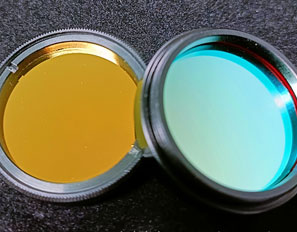
Fluorescence signals in biological applications are inherently weak and often overwhelmed by much stronger excitation light. Optical filters play a critical role in isolating these faint signals with high precision.
Core Challenges
Ultra-high signal-to-noise ratio (SNR): Excitation light must be effectively blocked, while fluorescence signals are transmitted with maximum efficiency.
Minimal autofluorescence: Filter substrates and coatings must not generate any detectable background fluorescence under excitation.
Precise spectral control: Sharp transition edges and accurate cut-off characteristics are essential to ensure clean signal separation.
High transmission efficiency: Maximum transmission within the passband is required to capture as many photons as possible.
Angular stability: The filter response must remain stable under varying angles of incidence to prevent wavelength shifts that could affect quantitative analysis.
Key Filter Types
Excitation filters: Positioned before the light source, allowing only specific excitation wavelengths to pass.
Emission filters: Placed in front of the detector, transmitting fluorescence signals while effectively blocking excitation light.
Dichroic mirrors (beamsplitters): Typically set at a 45° angle, reflecting excitation light toward the sample while transmitting emitted fluorescence.
Standard Fluorescence Filter Set
A typical fluorescence filter set consists of three components:
Excitation Filter
Function: Selects the wavelength range required to excite fluorescent dyes or proteins.
Requirements: High transmission (>90%) within the excitation band, combined with deep blocking in other regions—especially within the emission range (typically OD 6 or higher).
Dichroic Mirror / Beamsplitter
Function: Positioned at an angle (commonly 45°), it reflects excitation light toward the sample and transmits emitted fluorescence to the detector.
Requirements: High reflectance (>99%) in the excitation band and high transmission (>90%) in the emission band. A very steep transition edge is critical for effective spectral separation.
Emission Filter
Function: Further refines the fluorescence signal before detection, transmitting only the desired emission wavelengths while eliminating any residual excitation light.
Requirements: High transmission within the emission band, combined with extremely deep blocking of excitation wavelengths (OD 6 as a baseline, with OD 8+ required for advanced applications). This component is critical for achieving high signal-to-noise performance.
Recommended Coating Technology: Ion Beam Sputtering (IBS)
For high-end fluorescence applications—such as confocal microscopy, high-content screening, and flow cytometry—ion beam sputtering (IBS) is widely regarded as the industry benchmark.
Key Advantages of Ion Beam Sputtering
Ultra-low absorption and scattering: Coating density approaches that of bulk materials, resulting in minimal optical loss.
Excellent uniformity and repeatability: Ensures consistent performance across large production batches.
Outstanding environmental stability: Dense, hard coatings provide long-term durability with minimal sensitivity to environmental factors.
Precise thickness control: Enables the realization of steep spectral edges and complex multilayer designs.
Although IBS systems involve higher capital cost and lower deposition rates, the resulting performance—particularly in terms of signal-to-noise ratio and long-term stability—is essential for high-value scientific and clinical instruments.
Hello Can we help you? We have over 20 years of experience in the PVD field. If you have any requirements, please feel free to contact us via WhatsApp.